






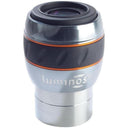




7mm
High powerFor lunar detail, planets and close double stars when the atmosphere and telescope support high magnification.
- Eye relief
- 12mm
- Field stop
- 15mm
- Weight
- 306g
 Authorised Dealer

Celestron Luminos · Ultra-wide eyepieces
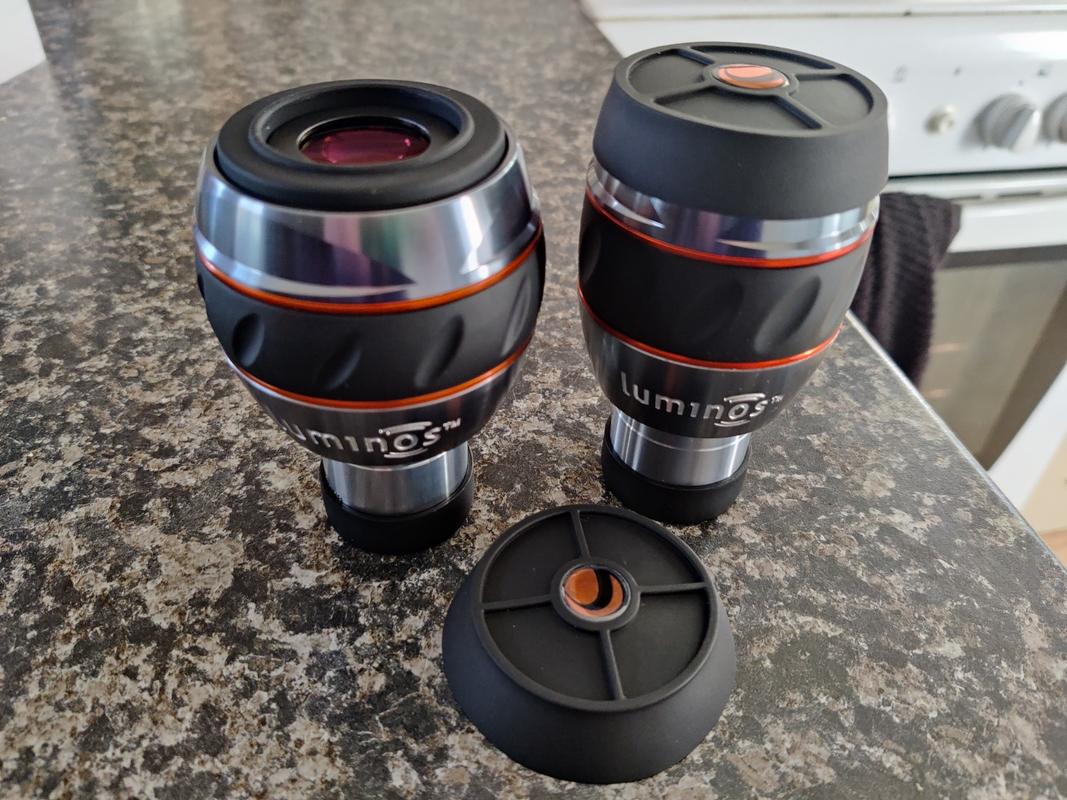
An 82° apparent field changes the feel of observing: less like looking down a tube, more like leaning into the sky. Choose from six parfocal focal lengths spanning high-power planetary detail to expansive deep-sky sweeps.


The immersive difference
Apparent field of view describes how wide the circular window feels to your eye. At the same magnification, the Luminos 82° window spans roughly 64% more angular width than a 50° eyepiece.
That extra room is useful as well as dramatic. A target can stay visible longer in a manually tracked telescope, surrounding star fields provide context, and large clusters or nebulae feel less confined.
The complete family
Shorter focal lengths produce more magnification; longer focal lengths show a broader true field. The most useful choice depends on your telescope’s focal length, aperture, focuser size and the targets you enjoy.
For lunar detail, planets and close double stars when the atmosphere and telescope support high magnification.
A strong planetary and lunar option that also brings globular clusters and compact deep-sky objects closer.
A flexible bridge between detail and context—well suited to the Moon, clusters, galaxies and smaller nebulae.
A 2″ generalist for deep-sky detail, framed lunar views, rich star fields and medium-size open clusters.
For larger clusters, sweeping along the Milky Way, broad nebulae and an easy low-power route into a target.
The broadest true field in the family for extended nebulae, very large clusters and immersive star-field cruising.
A practical starting map
These are observing roles, not rigid rules. The same eyepiece can behave very differently in a 400mm refractor and a 2800mm Schmidt-Cassegrain—use the calculator above to translate the range to your telescope.
Moon, planets and tight doubles on steady nights.
Planets, lunar features, globulars and planetary nebulae.
Moon, globular clusters, galaxies and smaller nebulae.
Galaxies, rich fields, lunar framing and open clusters.
Large clusters, broad nebulae and easy target finding.
Very large targets, maximum family field and navigation.
Start low, then climb. A longer focal length usually makes a target easier to locate. Centre it, focus carefully, then move to a shorter focal length if the atmosphere and object reward more power.
Check the mechanical fit
The number on the eyepiece sets magnification; the barrel diameter decides whether it physically fits. The heavier 2″ models also change the load at the back or side of the telescope.
The 7, 10 and 15mm models fit standard 1.25″ holders. The 19, 23 and 31mm models require a 2″ focuser or 2″ diagonal.
The family grows substantially from the compact 7mm to the 1.186kg 31mm. On a Dobsonian, small mount or light focuser, that difference can shift balance or demand more tension.
Before letting go: secure the eyepiece, confirm the diagonal and focuser can carry it, and test telescope balance through the full altitude range.
Built for hands-on observing
The optical idea is ambitious; the handling is deliberately simple. A broad rubber centre grip controls the retractable eyecup, while anodised aluminium bodies and threaded barrels make the range feel at home in a serious observing kit.


Every air-to-glass surface receives multiple coating layers to support light transmission, contrast and clean colour.
Rotate the broad rubber grip counter-clockwise to raise the eyecup or clockwise to lower it for glasses and personal eye position.
Swap between Luminos focal lengths with little or no refocusing. A small touch-up can still be normal across telescopes and observers.
Add compatible nebula, colour or neutral-density filters directly to the insert barrel; match the filter diameter to the eyepiece.
From case to first light
Eyepieces are simple to install, but a careful routine protects the barrel, the telescope and the object you just spent time finding.
Use a longer focal length to locate and centre the target. Check that the eyepiece barrel matches the focuser or diagonal.
Loosen the holder, insert the chrome barrel fully, then tighten gently until snug. Do not overtighten or mark the barrel.
Focus on the target, then rotate the rubber grip to place the eyecup where the full field is comfortable and stable.
Move to a shorter focal length for more detail. If the image becomes soft, dim or restless, step back to lower power.
Every number in one place
Current Celestron specifications for all six individual variants. Dimensions are overall height × width × depth.
| Specification | 7mm | 10mm | 15mm | 19mm | 23mm | 31mm |
|---|---|---|---|---|---|---|
| Celestron SKU | 93430 | 93431 | 93432 | 93433 | 93434 | 93435 |
| Barrel size | 1.25″ (32mm) | 1.25″ (32mm) | 1.25″ (32mm) | 2″ (50.8mm) | 2″ (50.8mm) | 2″ (50.8mm) |
| Focal length | 7mm | 10mm | 15mm | 19mm | 23mm | 31mm |
| Apparent field | 82° | 82° | 82° | 82° | 82° | 82° |
| Field stop | 15mm | 17mm | 26mm | 30mm | 37mm | 47mm |
| Lens elements | 8 | 7 | 7 | 6 | 6 | 6 |
| Lens groups | 5 | 5 | 4 | 4 | 4 | 4 |
| Eye relief | 12mm | 12mm | 17mm | 20mm | 20mm | 27mm |
| Dimensions | 89.5 × 54 × 54mm | 91 × 57.5 × 57.5mm | 87 × 62 × 62mm | 93.5 × 67.5 × 67.5mm | 110.5 × 80.5 × 80.5mm | 125.5 × 93 × 93mm |
| Weight | 306g | 329g | 366g | 500g | 800.5g | 1186g |
| Optical coatings | Fully multi-coated | Fully multi-coated | Fully multi-coated | Fully multi-coated | Fully multi-coated | Fully multi-coated |
| Parfocal | Yes | Yes | Yes | Yes | Yes | Yes |
| Filter threads | Yes | Yes | Yes | Yes | Yes | Yes |
| Retractable eye guard | Yes | Yes | Yes | Yes | Yes | Yes |
| Waterproof | No | No | No | No | No | No |
Swipe or scroll the table sideways to compare every model.
Before you choose
No. Each variant is one individual Luminos eyepiece in the selected focal length. The page covers all six so you can compare them accurately before choosing.
Start by entering your telescope details in the calculator. Look for a useful gap in your existing eyepieces rather than duplicating a similar magnification. A lower-power option is often the most forgiving first view; shorter focal lengths are more dependent on aperture, collimation and atmospheric steadiness.
Not in a 1.25″-only holder. Those three models have 2″ barrels and require a compatible 2″ focuser or 2″ diagonal. A 1.25″-to-2″ adapter enlarges the holder for smaller eyepieces; it cannot make a 2″ eyepiece fit a smaller opening.
The six Luminos eyepieces are designed around a common focus position, so switching within the family usually needs little or no focuser movement. Small differences in eyesight, telescope accessories and seating can still call for a fine adjustment.
Lower the twist-up eyecup to bring glasses closer to the eye lens. The published eye relief is 12mm on the 7 and 10mm, 17mm on the 15mm, 20mm on the 19 and 23mm, and 27mm on the 31mm. Whether you can see the complete 82° field depends on your frames, facial geometry and required eye position.
Yes, when the accessory matches the barrel format and mechanical load. Each Luminos barrel is filter-threaded. A compatible Barlow increases magnification, so calculate the resulting power before use—especially with the 7 and 10mm models.
No single eyepiece is best for every telescope. The 31mm gives the broadest Luminos true field, but in a fast telescope it may produce an exit pupil larger than your eye can use. Sky brightness, focal ratio, obstruction, balance and target size all matter. The calculator helps reveal that trade-off.
No. Celestron lists every Luminos eyepiece as not waterproof. Protect them from rain and spray, dry dew before storage, and keep the caps fitted when they are out of the telescope.
Official help and specifications
Setup guidance, the manufacturer’s full eyepiece chart and local help from Jacobs Digital.
Choose the Luminos focal length that best complements your telescope. If you are between two sizes, compare magnification, true field, exit pupil and barrel format—not just the millimetre number.
 New Zealand
A shout to Jacobs for getting this E.P in. I had read many reviews some saying it was great, some saying that it is not for a refractor and everything in between; at $718.00 delivered I thought it is going to be an expensive trial if E.P -- Is substandard or a keeper for the Celestron Nexstar 8 Se that I purchased from Jacobs 12 months ago --- it is a keeper, I feel I am on the International Space Station it gives you a view of and incredible amount of space. Living is Hastings NZ, and currently the moon is full it will take in the whole moon insane, yes there is some softening just on the edges but for price point what would you expect? There is much I could write, but for me the measure of a product is would I recommend it to my best mate, or my family and the answer is and unequivocal Yes!!! E.P is very big, and I would not put it on a small scope. But on my 8" Celestron it works perfectly. One always has to measure apples with apples not apples with oranges a Tele Vue 31 mm Nagler type 5 E.P would set you back $2500.00 NZ dollars it is not a Tele Vue in quality but for price point it is hard to beat.
New ZealandExcellent build quality , and twist up eyecup. Tested in a 6" f8 GSO dobsonion. Excellent clarity and stars were sharp to edge of field. The 82' fov is great especially at the higher powers. Could frame nearly all of Orion nebula in the 7mm with stars of the trapezium in sharp focus. Definitely worth as an upgrade over the standard plossls.
Jacobs Digital is a speciality on-line retailer, as well as a brick-and-mortar retail store, operating in the same Auckland, NZ location for over 40 years.
9 Mokoia Road
Birkenhead
Auckland 0626
New Zealand
+64 (9) 480-5903


