










Telescope Buying Guide
Aperture is important
One of the most important aspects of any telescope is its aperture, the diameter of its main optical component, which may be either a lens or a mirror. A scope's aperture determines both its light-gathering ability (how bright the image appears) and its resolving power (how sharp the image appears).
With a 6-inch telescope you can discern craters on the moon as small as about a mile across, half the size of those visible in a 3-inch scope (under the same conditions, using the same magnification).
The advantage of a larger aperture becomes more apparent when looking towards a distant galaxy on a moonless night. Because the surface area of a 6-inch mirror is four times greater than that of a 3-inch mirror, it collects four times as much light, meaning the galaxy would appear four times brighter. (Astronomically speaking, that's 1.5 magnitudes brighter.)
Aperture and image quality

Jupiter under ideal viewing conditions. Left: 2" aperture. Right: 4" aperture.
Magnification is not clarity
Magnification is determined by your telescope's focal length and your eyepiece. Most of the telescopes we sell come with two eyepieces, and swapping one out for the other will produce a greater or lesser magnification.
Every telescope has a maximum effective magnification. The figure usually given is twice the aperture's diameter in millimetres (i.e. a 60mm telescope will have a maximum of 120x). However, in most cases you will find the scope limited by atmospheric conditions long before you reach the maximum.
You can always buy another eyepiece if you find yourself wanting more or less magnification, but you cannot change your telescope's focal length. This is why magnification is not very important, and you should be looking at the aperture first.
Telescope brightness compared to the human eye
| Telescope aperture | Light gathering increase |
|---|---|
| 70mm | 100x |
| 80mm | 130x |
| 102mm | 212x |
| 120mm | 293x |
| 130mm | 344x |
| 150mm | 459x |
| 200mm | 816x |
| 250mm | 1275x |
Compared to a fully dark-adapted human eye (approximately 7mm pupil).
Looking beyond aperture
Okay, so a telescope's ability to gather light is paramount. Should you, then, look for the largest telescope you can possibly afford? Maybe, but not necessarily. You also need to consider portability and ease of use. After all, what good is a telescope you don't use?
Before you consider specific telescope options, ask yourself where you will want to use your new telescope. If the answer is in the backyard, then a great big telescope might be perfect. But if you want to take your telescope to dark-sky locations for better viewing away from city lights, size and weight become important factors. If you plan on taking your scope on camping trips, it will be sharing space in your car with other gear.
You'll also want to think about the complexity of your telescope setup. If you want to be able to take a quick peek at the night sky, choose a simple telescope that sets up in just a few minutes. If you choose a bulky, complicated telescope, it will probably spend more time in the garage and you'll spend less time under the stars.
Optical styles
This is a complex subject, so we'll keep it short. Choosing an optical design should not influence you more than getting a good aperture. Each design has pros and cons.
Refractor
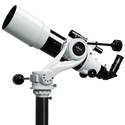
This is the telescope shape you're probably most familiar with. The main optical element is a lens on the front which refracts light directly onto a mirror at the back and into the eyepiece.
Pros
- Can be used for terrestrial viewing, although some will flip the image upside down without an additional accessory
- Sealed tube protects optics
- No maintenance required
Cons
- Consumer units are not available in sizes greater than 150mm aperture
- Heavier than other optical designs
- Less value than a reflector

Reflector
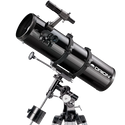
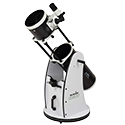
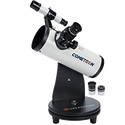
As the name suggests, this design has a mirror at the end of its tube which gathers light before sending it through another mirror into the eyepiece. Dobsonians are a type of reflector.
Pros
- Consumer units are available in sizes up to 500mm, providing an unparalleled view of faint, deep-sky objects
- More value than refractors
- Low weight
- Available in more portable 'collapsible' units
Cons
- Open tube can collect dust
- Requires collimation maintenance
- Highly impractical for terrestrial viewing, as the image is flipped and upside down

Compound (Catadioptric)
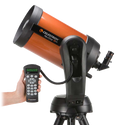
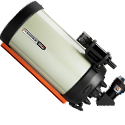
This type of telescope features two mirrors (one in the back and one in the front) plus a corrector lens. Many different types of compound design exist, Schmidt-Cassegrain being the most common.
Pros
- Excellent image quality
- Sealed tube protects optics
- Great for astrophotography
- Portable
Cons
- More costly than other designs
- Requires some maintenance
- Second mirror reduces brightness
Mounts and how they move

Altazimuth mounts (AZ)
Altazimuth (from altitude + azimuth) is the simplest telescope mount design, as it pivots on two axes (see image) relative to the ground. Modern telescopes with altazimuth mounts often have computer control or a manual fine adjustment knob to precisely track objects. It's all about giving you maximum control over how the telescope moves.

Equatorial mounts (EQ)
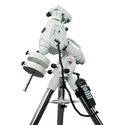
In simple terms, equatorial mounts are designed to follow the rotating night sky as the Earth turns. While you need to adjust two directions with an altazimuth mount, you align the equatorial mount to the Earth's axis (pole to pole). This way you can slowly turn it and objects in the sky will appear to stand still in your field of view.
It's definitely a bit harder to use, but for astrophotography this type of telescope mount is the best choice if it's motorised. Once practised, it's the ideal movement type for a telescope and ultimately improves your viewing experience.
GoTo mounts
A GoTo mount can find and track objects in the night sky. Newer models even have built-in Wi-Fi that can pair up with your smartphone to control the mount remotely. They can also be computer controlled.
These mounts have a setup process that takes a few minutes and naturally require power (either from batteries or a power outlet). However, once they're going, finding and viewing objects is effortless. They're particularly useful for lunar and planetary viewing.
They come in either AZ or EQ movements. For astrophotography, an EQ GoTo mount is ideal.
Astrophotography
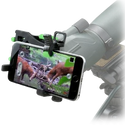
Astrophotography is a very deep subject. You can start out by using almost any telescope we sell with a smartphone and adapter. Or, if you already own a DSLR or mirrorless camera, it can be mounted onto many telescopes. However, if you want to capture the best of the night sky, you will need the right gear:
- A motorised equatorial mount
- An astrophotography tube (OTA)
- A DSLR, mirrorless or astrophotography CCD camera
- Scope to camera adapters (varies with OTA type)
Once you have a proper setup, there are additional options you can use to get even better results, like auto guiders, focal reducers and filters. Astrophotography can be a highly rewarding hobby, and when it comes to the results, the sky is truly the limit.
Still need more help?
Our staff are experienced experts and would be more than happy to talk about options for you. Please call or email us today. Ready to gaze upon our telescope range? We have telescope options at any price range, size and level of automation.