






























Binocular Buying Guide
What do you need from your binocular? The right choice depends on how you'll use it, so start with the purpose below that best matches yours.
General purpose
If you don't have a specialist purpose in mind, you have plenty of choice. If you have a great view and expect to keep them at home, then your best choice might be a large bulky pair. But if you want something to take hiking, go for something more compact.
But how much magnification do I need?
8x or 10x is suitable for most people in most cases. If you think you need significantly more, you may want to consider a spotting scope.
I've heard about auto-focus, what's that?
'Auto-focus' or 'focus-free' is a marketing term. What this actually means is the binocular has its focus fixed to infinity, and the optics are designed so that most of the image is in focus at once. Your eyes do the rest. The downside is that older people, or people who naturally have trouble focusing, may find them uncomfortable or even impossible to use.
I'm looking for a binocular for someone with unsteady hands
A binocular with a lower magnification is easier to hold steady. Alternatively, consider getting a binocular that can be fitted to a tripod.
Hunting, birding and safari
If you're looking for wildlife in the field, you'll want a binocular that provides a bright image even in low light. The binocular will also need to be robust and weatherproof so that it isn't a liability in the field.
For hunters
10x42 has become ubiquitous, and for good reason. It is not overly cumbersome, but still large enough to provide a bright image.
For safari
As with hunting, a larger lens size and a higher magnification is preferable, especially if you're looking for wildlife at dawn and dusk.
For birders
New Zealand's most popular birding spec is 8x42. Much of our bird life is small and found beneath dense canopy, and 8x42 will provide a bright view that's wider than a 10x. This is ultimately a guideline, and you may find an entirely different spec to be preferable for you.
Marine
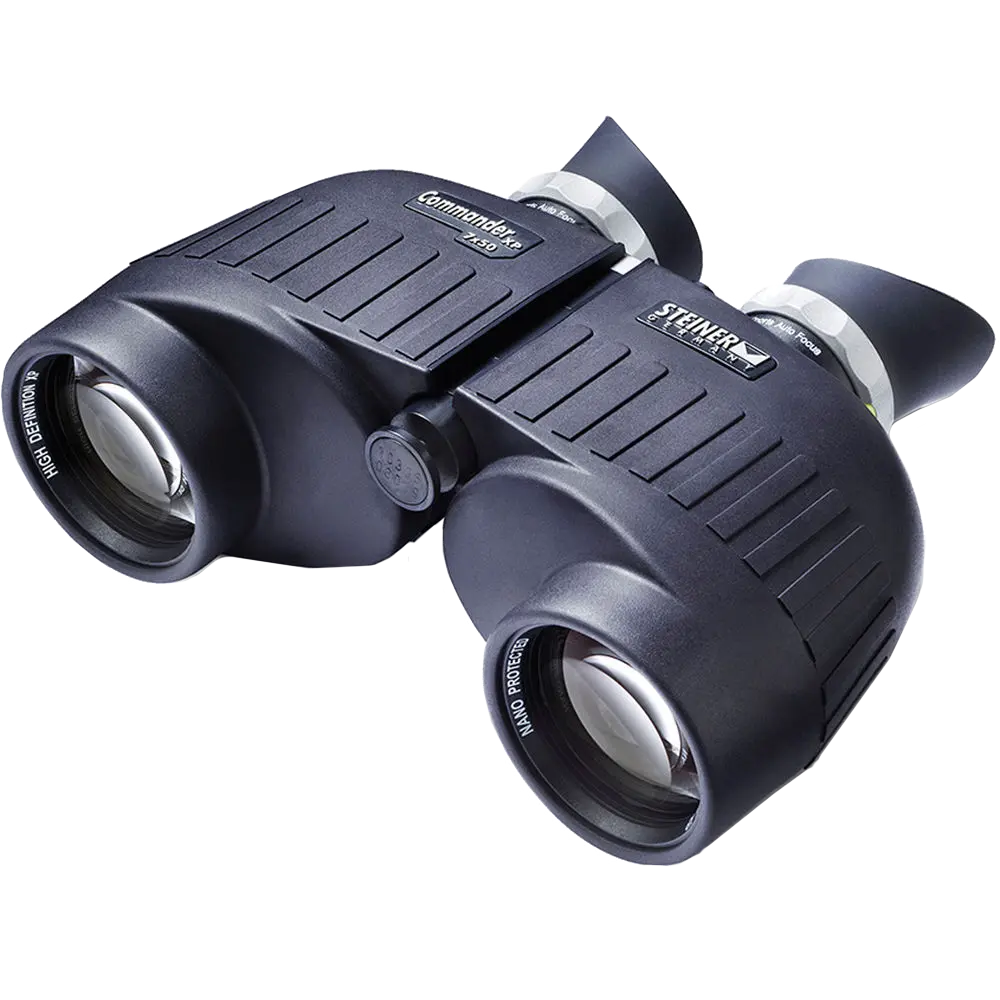
If you're on a boat, you'll want a binocular that provides a bright, stable image in a rugged, waterproof body. Marine binoculars are typically 7x50 in the porro design. Low magnification and a large size make them incredibly quick and easy to use. This simple convenience is invaluable when you need to quickly identify potential hazards at sea.
The typical marine binocular is highly resistant to salt water corrosion. If you live near the sea, or need a binocular to use from the beach, a marine binocular might be the right type for you.
What the numbers mean
Every binocular is described by two numbers. Using a 7x50 binocular as the example:

The first number is the magnification
For example, 7x50 binoculars have a magnification power of 7. This means the object appears 7 times closer than with the naked eye. If you were looking at a boat 100 metres away, using a pair of 7x binoculars would make that boat appear to be around 14 metres away.
The second number is the diameter of the objective lens
Light enters the binoculars through the objective lens. The size of the lens will determine the brightness of the image, as well as the exit pupil rating, which is used to measure performance in low light conditions.
The magnification (7) divided by the lens diameter (50) = a 14mm exit pupil diameter. The higher the number, the brighter the image during low light viewing.
Field of view
Field of view determines how much you see horizontally, in clear conditions, at 1000 yards (914 metres). More is better, and not all binoculars are built equally in this respect.

Manufacturers don't agree on how to express this on their specifications either, so if you want to work it out yourself, here are the formulas. The first thing to know is that 1 degree = 52.5 feet at 1000 yards. From there you can start calculating.
Worked example: an 8x42 with a 360ft field of view
| Value | Result |
|---|---|
| Field of view (FoV) | 360ft |
| Angle of view (AoV): 360 ÷ 52.5 | 6.9° |
| Apparent angle of view (AAoV): 6.9 × 8 | 55.2° |
By flipping these basic formulas, you can extrapolate any of the other values. To show the relationship between magnification and FoV: if the binocular above was a 10x instead and the FoV was the same, the angle of view would remain 6.9°, but the apparent angle would be pumped up to 69°.
Prism types
Roof prism
Straight profile, eyepieces in line with the objective lenses, fairly new design.
Pros
- More impact resistant than porro prisms
- Compact
- Lightweight
- Normally waterproof
- Higher optical quality; most top-end binoculars use roof prisms
Cons
- More expensive than porro prism binoculars
- Slight image quality loss when not coupled with phase correction technology (most, if not all, binoculars we sell have this technology)
Porro prism
Classic design, eyepieces set closer together than the objective lenses.
Pros
- Better image quality for your buck at the low end of the price scale
- Typically have a brighter image due to a larger objective lens
- Low cost
Cons
- Often not waterproof
- Bulkier than roof prism binoculars
- Less impact resistant than roof prisms
So what's right for me?
Ultimately, what's right for you will depend on your personal preferences and your specific requirements. If you have any further questions, don't hesitate to contact us for some expert advice.
Still need more help?
Our staff are experienced experts and would be more than happy to talk about options for you. Please call or email us today, or browse the largest range of binoculars in New Zealand. With over 300 pairs to offer, we are sure to have the right fit for you.


